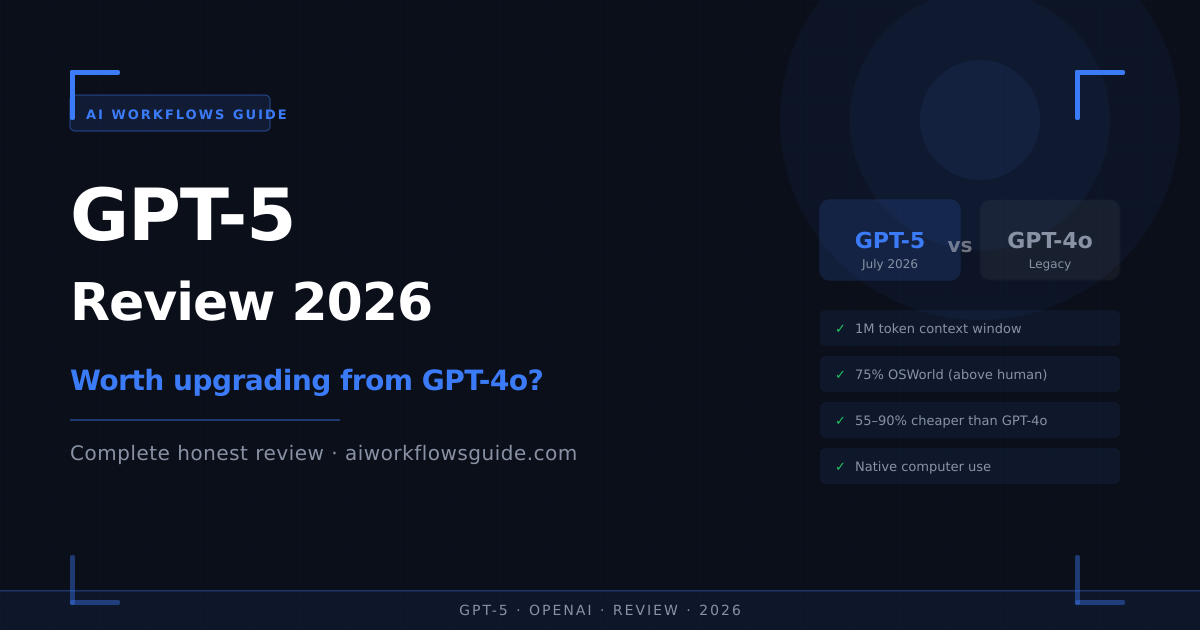
GPT-5 review 2026: the short answer is yes, it’s worth upgrading — but the longer answer depends entirely on which version of GPT-5 you’re talking about, because OpenAI has shipped seven distinct versions in under a year.
GPT-5 launched in August 2025 as OpenAI’s biggest model leap since GPT-4. By July 2026, the current flagship is GPT-5.6, with GPT-5.4 remaining the most widely deployed version for business and developer use. Each iteration has brought meaningful changes in capability, pricing, and use case fit — and the gap between what GPT-4o could do and what GPT-5.4 delivers is genuinely large.
This GPT-5 review covers what changed, what it costs, how it compares to Claude and Gemini, and whether the upgrade makes sense for your specific workflow.
Table of Contents
The GPT-5 Family: Every Version at a Glance
In under a year, OpenAI has shipped seven distinct versions of GPT-5, each with its own identity and price point. Here’s the map this GPT-5 review is based on:
| Model | Released | Key Change |
|---|---|---|
| GPT-5.0 | August 2025 | Original launch — unified reasoning + fast base model |
| GPT-5.1 | October 2025 | Reliability and instruction-following improvements |
| GPT-5.2 | December 2025 | Coding + reasoning upgrade (now retired June 2026) |
| GPT-5.3 | February 2026 | Tone fix — less hedging, more direct responses |
| GPT-5.4 | March 5, 2026 | Current flagship — coding, computer use, knowledge work unified |
| GPT-5.5 | May 2026 | Reasoning and agentic improvements |
| GPT-5.6 | July 9, 2026 | Latest frontier model, three tiers: Sol, Terra, Luna |
The model most business users are working with today is GPT-5.4 — available on ChatGPT Plus and above, and the default API model for most production workloads.
GPT-5 Review 2026: What Actually Changed from GPT-4o
Architecture: Unified Reasoning
The original GPT-5 was built as a unified system with a fast base model for everyday queries and a deeper reasoning layer (GPT-5 Thinking) that activates automatically when the query demands it. A real-time router decides which to use based on complexity, tool needs, and context, so you don’t have to manage it manually.
Of all the changes in this GPT-5 review, this one matters most in practice. With GPT-4o, you had to manually choose between speed and reasoning — picking between the standard model and o1/o3 for complex tasks. GPT-5 handles that routing automatically, which simplifies workflows significantly.
Context Window: 400K → 1M Tokens
GPT-4o has a 128,000 token context window, while GPT-5 has a 400,000 token context window. GPT-5.4 extended this further to 1 million tokens — though input tokens above 272K are charged at 2x the standard rate.
For most business use cases, the practical implication is that GPT-5 can process entire codebases, lengthy legal documents, or extended conversation histories in a single context without chunking. GPT-4o regularly hit limits on these tasks.
Computer Use: Beyond Text
GPT-5.4 scores 75% on OSWorld (computer use), surpassing the human expert baseline of 72.4%. No other model has crossed that threshold.
This means GPT-5.4 can navigate GUIs, click buttons, fill forms, and interact with software — not just generate text about how to do it. For businesses building automation workflows, this is a genuinely new capability that GPT-4o didn’t have.
Coding: Major Jump
GPT-5 outperforms GPT-4o in coding (75% vs 31%), math, multimodal reasoning, and factual accuracy. On SWE-bench Pro — the harder, less-gameable coding benchmark — GPT-5.4 Standard scores 57.7%.
For context, Claude Opus 4.6 scores 80.8% on SWE-bench Verified (a slightly different benchmark), which is why Claude remains the developer preference for pure coding work. But GPT-5.4 has closed the gap substantially from where GPT-4o stood.
Tone: GPT-5.3 Fixed the “Cringe” Problem
Previous GPT-5 versions had a tendency toward excessive caveats, unnecessary hedging, and what users called “cringe” — AI overcaution that made every answer feel like a legal disclaimer. GPT-5.3 dialed that back, producing more direct and natural responses. It also delivered a meaningful accuracy improvement — with web search enabled, GPT-5.3 produces 26.8% fewer hallucinations than GPT-5.2.
This is one of the most practically significant improvements that doesn’t show up in benchmark tables. GPT-5.4 and beyond maintain this more direct tone.
GPT-5 Pricing in 2026: The Full Breakdown
ChatGPT Consumer Plans
ChatGPT pricing in 2026 ranges from $0 to $200/month for individuals and $25–$30/user/month for teams. OpenAI now offers six plans — Free, Go, Plus, Pro, Business, and Enterprise — all powered by GPT-5.4.
| Plan | Price | GPT-5 Access |
|---|---|---|
| Free | $0 | GPT-5.4 limited, with ads (US) |
| Go | $8/month | GPT-5.4 Instant, more messages |
| Plus | $20/month | Full GPT-5.4 Thinking, Codex, computer use |
| Pro | $200/month | Highest limits, GPT-5.4 Pro |
| Business | $25/user/month | Workspace privacy, admin controls |
| Enterprise | Custom | Maximum limits, enterprise security |
For most regular users, ChatGPT Plus at $20/month unlocks generous GPT-5.4 Thinking limits, DALL·E, Sora, Deep Research, advanced voice mode, native computer use, Codex, and an ad-free experience.
API Pricing
GPT-5.4 supports up to 1 million tokens of input context. Input tokens beyond 272K are charged at double the standard rate.
The API model variants and their pricing:
| Model | Input (per MTok) | Output (per MTok) | Best for |
|---|---|---|---|
| GPT-5.4 Nano | ~$0.10 | ~$0.40 | Edge, mobile, high-volume simple tasks |
| GPT-5.4 Mini | ~$0.40 | ~$1.60 | High-volume production workloads |
| GPT-5.4 Standard | ~$1.75 | ~$14 | General production use |
| GPT-5.4 Pro | Higher | Higher | Complex reasoning, enterprise tasks |
The GPT-5 API is up to 55–90% cheaper than GPT-4o across common use cases, thanks to lower per-token pricing and a 90% caching discount.
The cost reduction compared to GPT-4o is significant. A 10-person engineering team can save $7,200/year net using GPT-5 just on pull request reviews.
GPT-5.4: The Current Flagship in Detail
Released March 5, 2026, GPT-5.4 represents a fundamental shift in what a single model can do. Rather than offering separate specialist models for coding, reasoning, and computer use, GPT-5.4 rolls everything into one unified architecture.
It scores 57.7% on SWE-bench Pro (coding), 75% on OSWorld (computer use), and 83% on GDPval (knowledge work) — making it the first model that credibly handles all three domains at frontier level.
The five GPT-5.4 variants:
GPT-5.4 Mini scores 54.38% on SWE-bench Pro — remarkably close to Standard’s 57.7% — at roughly 6x lower cost (~$0.40/$1.60 per MTok). For teams running high-volume, latency-sensitive workloads — chat support, content generation, lightweight code completion — Mini is the clear choice.
GPT-5.6: What’s New in July 2026
The latest version, GPT-5.6, went fully public on July 9, 2026. It ships in three tiers — Sol (flagship), Terra (balanced), and Luna (cheapest) — with Sol scoring 88.8% on Terminal-Bench 2.1 and a 1.05M-token API context window.
GPT-5.6 Luna is the cheapest frontier model currently available from any major provider. For cost-sensitive teams that need frontier capability without frontier pricing, it’s worth evaluating — though it’s too new to have reliable third-party benchmark data yet.
GPT-5 vs Claude vs Gemini: Honest Positioning
No GPT-5 review is complete without the competition. The picture in July 2026 is clearer than the benchmark tables suggest:
GPT-5.4 leads on:
- Computer use (75% OSWorld — above human baseline, no other model matches this)
- Knowledge work and professional tasks (83% GDPval)
- Ecosystem breadth — 7,000+ integrations, DALL·E, Sora, Advanced Voice
- Consumer plan value at $20/month
Claude leads on:
- Coding precision (Claude Opus 4.6 at 80.8% SWE-bench Verified vs GPT-5.4 at 57.7% SWE-bench Pro — different benchmarks, but directionally consistent)
- Writing quality and instruction-following fidelity
- Long document processing with 200K token context
- API cost efficiency for production workloads (Sonnet at $3/MTok input)
- Developer preference: 70% of developers prefer Claude for coding tasks
Gemini 3.5 leads on:
- Largest context window (2M tokens on Pro)
- Google Workspace integration
- Reasoning benchmarks (ARC-AGI-2, GPQA)
- Deep Research powered by Google’s search infrastructure
We’ve covered Claude vs ChatGPT in depth in our ChatGPT vs Claude for Business in 2026 guide, and the full model comparison in Best AI Model 2026: Claude vs GPT vs Gemini for Automation.
Real Business Use Cases: Where GPT-5 Wins
Customer service automation: GPT-5.4’s computer use capability means it can actually navigate your support software, not just generate responses. For teams building AI support agents, this eliminates a layer of integration complexity.
Content at scale: GPT-5.4 Mini at $0.40/MTok input makes high-volume content generation economically viable. A team generating 1,000 product descriptions per week is looking at cents per piece, not dollars.
Code review pipelines: Code review tools that analyze multiple files from the same repository can reuse system prompts, development context, and even snippets of code — achieving 80% cache hits across interactions. Combined with the 90% caching discount, this makes automated code review dramatically cheaper than it was with GPT-4o.
Document analysis: The 1M token context window means you can feed GPT-5.4 an entire contract portfolio, annual report, or codebase in a single query. For legal, financial, and compliance teams, this is the most practically significant capability upgrade.
Should You Upgrade from GPT-4o?
Here is the practical verdict of this GPT-5 review, situation by situation.
Upgrade immediately if:
- You’re using GPT-4o via API — GPT-5 is cheaper per token AND more capable. There’s no reason to stay on GPT-4o for most workloads.
- You need computer use capabilities — GPT-4o has none.
- You’re running coding workflows — GPT-5.4 is substantially better.
- You hit GPT-4o’s 128K context limit regularly — GPT-5.4’s 1M context resolves this.
No urgent rush if:
- You’re on ChatGPT Plus and primarily use it for writing — the quality difference for everyday writing is smaller than the benchmark gap suggests.
- You rely heavily on Claude for coding — Claude still leads on pure coding precision.
- You’ve built workflows around GPT-4o’s specific behavior — test GPT-5.4 before migrating production workloads, as response style has changed.
Don’t bother with GPT-5 if:
- Your primary use case is research with cited sources — Perplexity’s Deep Research is better suited for that job.
- You need the largest possible context window — Gemini 3.5 Pro’s 2M tokens beats GPT-5.4’s effective 272K (before the 2x price penalty kicks in).
- You’re primarily doing long-form writing or instruction-heavy workflows — Claude’s instruction-following precision still has an edge.
The Bottom Line
GPT-5 review 2026 conclusion: this is a genuine generational leap, not a marketing rebranding.
The version that matters most in this GPT-5 review is GPT-5.4 for production workloads, with GPT-5.6 Sol emerging as the new frontier for teams that need maximum capability. GPT-4o is effectively a legacy model at this point — faster and cheaper for some narrow use cases, but outclassed in every meaningful dimension by its successor.
If you’re paying $20/month for ChatGPT Plus, you’re already on GPT-5.4. If you’re using GPT-4o via API, switching to GPT-5.4 Mini or Standard will save you money and improve results simultaneously.
Since this GPT-5 review was first published, OpenAI has started rolling out GPT-6 models. GPT-5 models remain available, but if you are choosing a model today, also read our GPT-6 Sol vs Luna comparison and our GPT-5.6 Sol vs Terra vs Luna guide.
Agree or disagree with this GPT-5 review? Share your real-world experience in the comments — especially which version you’re on and what workload you’re running it for.
Related articles:
- ChatGPT vs Claude for Business in 2026: Which AI Actually Wins?
- Best AI Model 2026: Claude vs GPT vs Gemini for Automation
- Best AI Tools for Small Business in 2026: The Complete Guide
- Best AI Agents for Business Automation in 2026: Top 7 Tools Compared
- Claude API Tutorial 2026: Build Your First Automation