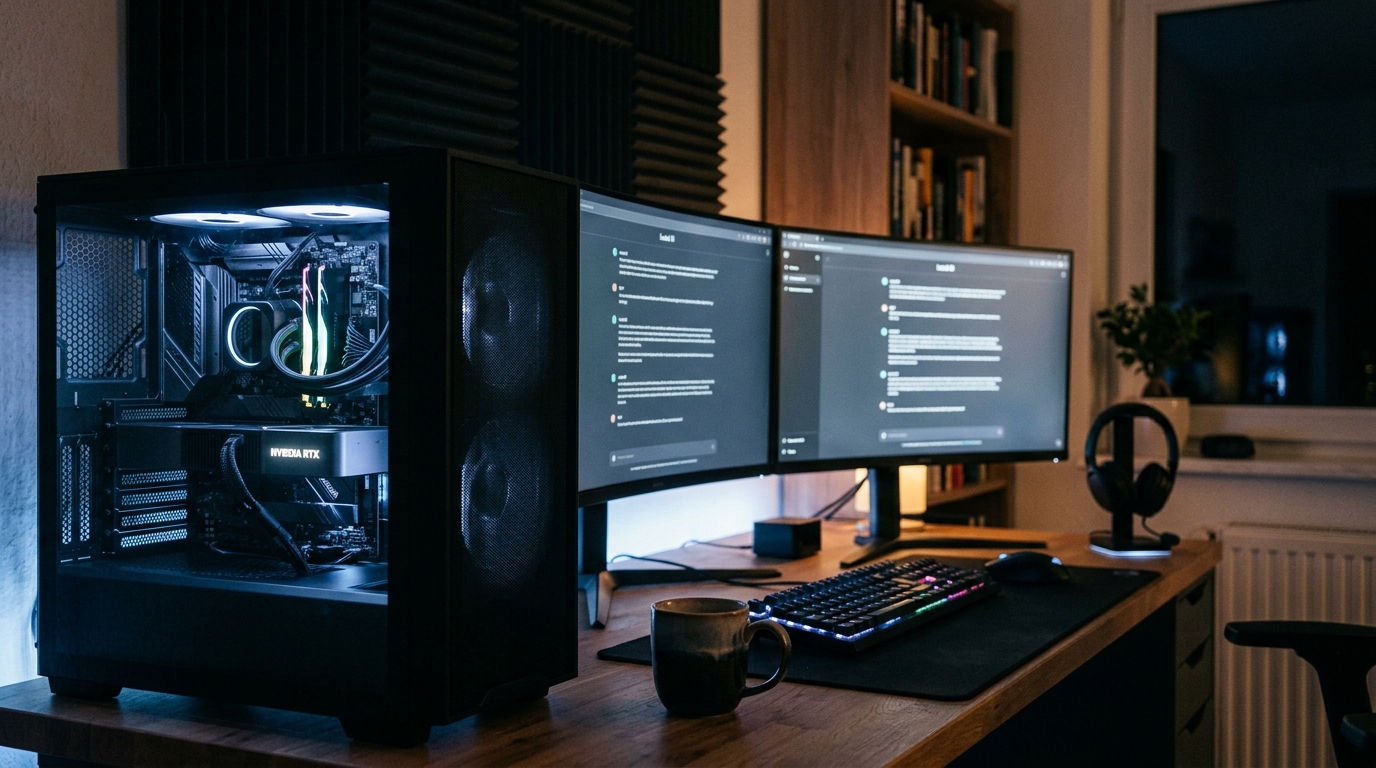
Perplexity portable computer is officially available on Windows, and it changes everything for RTX PC owners who want to run a fully local AI agent without touching the cloud. This release is one of the most significant milestones for offline AI enthusiasts in 2025, offering a no-subscription, no-credits approach to powerful AI inference.
Understanding why perplexity portable computer is such a game-changer requires a quick look at the current AI landscape. Most tools force you to send your data to remote servers, pay for API credits, or accept strict usage limits. This solution flips that model completely on its head.
Quick Comparison: Local AI Solutions for RTX PCs (2026)
| Feature | Perplexity Portable (Local) | Cloud AI (ChatGPT/Gemini) | Ollama (Self-hosted) |
|---|---|---|---|
| Cost | Free after setup | Subscription/Credits | Free |
| Privacy | 100% Local | Data sent to cloud | 100% Local |
| GPU Acceleration | RTX Optimized (CUDA) | Server-side only | CUDA/Metal |
| Agent Capabilities | Full local agent | Full (cloud) | Limited |
| Setup Complexity | Medium | Very Easy | Medium |
Perplexity Portable Computer Is: What You Need to Know Before Installing
Before you dive into the installation process, there are some critical prerequisites to understand. The perplexity portable computer is designed specifically to leverage NVIDIA’s CUDA architecture, meaning you will need an RTX-series GPU for the best possible performance.
The minimum recommended specs are an RTX 3060 with 12GB of VRAM, 16GB of system RAM, and Windows 11 64-bit. Lower VRAM cards can still run quantized models, but you will notice a significant drop in response speed and model quality.
One of the most important things to understand is that perplexity portable computer is not a cloud-wrapped desktop app. It runs inference entirely on your local hardware, meaning your queries, documents, and conversation history never leave your machine. This is a hard privacy guarantee that cloud services simply cannot offer.
You should also know about model compatibility. The platform supports GGUF-format models, which are the most widely available quantized model files for local inference. You can pull models from Hugging Face’s GGUF model library directly into the application without any additional conversion steps.
For those curious about how local inference compares to cloud performance, the NVIDIA RTX GPU lineup page provides detailed TOPS (tera operations per second) benchmarks that help you estimate real-world AI workload performance on your specific card.
Step 1: Download and Install the Perplexity Portable Runtime on Windows
The first practical step is downloading the Windows installer package. Head to the official Perplexity release page and grab the latest portable executable. The installer is a self-contained bundle, meaning you do not need to pre-install Python, Node.js, or any separate ML libraries.
Run the installer as Administrator. The setup wizard will automatically detect your GPU driver version and CUDA toolkit status. If your drivers are outdated, the installer will prompt you to update before proceeding — do not skip this step, as older CUDA versions cause significant inference slowdowns.
Once installed, the application creates a local directory at C:\Users\[YourName]\AppData\Local\PerplexityPortable. This is where your models, conversation history, and configuration files live. Keep this path in mind if you ever want to back up or migrate your setup to another machine.
Step 2: Download and Configure Your First Local Model
After installation, the next step is pulling a model. The built-in model manager makes this straightforward. Navigate to the Models tab inside the application and you will see a curated list of recommended models organized by VRAM requirement.
For RTX 3060 12GB users, the Llama 3.1 8B Q5_K_M quantization is the sweet spot — it fits comfortably in VRAM while maintaining near-full-precision quality. RTX 4090 owners can run 70B parameter models in Q4 quantization without breaking a sweat.
The model download happens directly within the app. Progress is shown in real time, and the application automatically validates the file hash after download to prevent corrupted model issues. This is a small but meaningful quality-of-life detail that separates it from manual GGUF setups.
Once the model is loaded, navigate to Settings and enable GPU Offloading. Set the GPU layers slider to maximum for your VRAM tier. This single setting can improve token generation speed by 300–500% compared to CPU-only inference.
If you want to compare quantization options before deciding, our guide to running Qwen3.8-27B locally covers the tradeoffs in detail.
Perplexity Portable Computer Is: Step 3 — Setting Up the Local AI Agent
This is where perplexity portable computer is truly different from a basic chat interface. The agent mode lets you give the AI access to tools: file reading, web search (fully local via a bundled search index), code execution, and even calendar integration on Windows 11.
To enable agent mode, go to the Agent tab and toggle “Enable Tool Use.” You will then see a list of available tools that you can activate individually. Start with File Reader and Local Search — these two alone unlock a massive portion of the agent’s practical value.
File Reader lets the AI ingest PDFs, Word documents, text files, and even images (with an enabled vision model). You can drop an entire folder of research papers and ask the agent to summarize, compare, or extract specific data points across all of them simultaneously.
Local Search uses a bundled Brave Search-compatible index that you can update on a schedule. This means your AI agent can answer questions about recent news without ever pinging an external server — a critical feature for users in sensitive professional environments.
The code execution sandbox is particularly powerful. The agent can write Python scripts, run them in an isolated environment, inspect the output, and iterate automatically. Combined with a capable model like Qwen2.5 Coder, this turns your RTX PC into a genuine autonomous coding assistant.
Perplexity Portable Computer Is Optimized for RTX: GPU Tuning Tips
Getting peak performance from your setup requires a few additional tuning steps. First, open NVIDIA Control Panel and set Power Management Mode to “Prefer Maximum Performance” for the Perplexity Portable executable. This prevents the GPU from throttling during long inference sessions.
Second, adjust the context window size. The default is 4096 tokens, but RTX 40-series cards with large VRAM can handle 16K or even 32K context windows with the right model. Larger context means the AI remembers more of your conversation — crucial for extended research sessions.
Third, enable Flash Attention if your model supports it. This algorithm dramatically reduces VRAM usage during attention computation, letting you run slightly larger models than your VRAM spec would normally allow. The option is in Settings under Advanced Inference.
For multi-GPU setups, perplexity portable computer is now capable of tensor-parallel inference across two RTX cards. This is an experimental feature but works reliably on RTX 4090 dual-GPU workstations, effectively doubling available VRAM and enabling 70B parameter models at full precision.
Perplexity Portable Computer Is: Common Mistakes to Avoid
Even experienced users make setup mistakes that cripple performance or cause stability issues. The first and most common is running a model that is too large for your VRAM. If a model doesn’t fit entirely in VRAM, layers spill over to system RAM, which is 10–20x slower. Always check VRAM requirements before downloading.
The second mistake is ignoring the system RAM requirement. Even though inference runs on the GPU, the model must first load from disk into system RAM before being transferred to VRAM. With 8GB of system RAM and a large model, you will experience severe loading delays and potential crashes.
Third, many users enable all agent tools simultaneously without understanding the performance impact. Each active tool adds overhead to every inference call. Start with one or two tools, measure performance, and add more only if your hardware handles the baseline smoothly.
Fourth, skipping model updates is a common oversight. Perplexity portable computer is regularly updated with new model support, quantization improvements, and bug fixes. Check the built-in update manager at least once a week to stay current with performance patches.
Fifth, not setting up automatic conversation exports. Your local conversation history is stored only on your machine, meaning a drive failure erases everything. Enable the auto-export feature under Settings to back up conversations as Markdown files to a location of your choice.
Privacy, Security, and Use Cases: Why Going Local Matters
The privacy case for local AI is straightforward but worth stating clearly. When you use a cloud AI service, your prompts, documents, and conversation history are transmitted to and processed on third-party servers. Even with strong privacy policies, this creates regulatory and confidentiality risks for professionals in legal, medical, financial, and defense sectors.
Running perplexity portable computer is locally eliminates this risk entirely. There is no telemetry, no data collection, and no usage logging by external parties. The only entity with access to your AI interactions is you.
From a use-case perspective, this opens up scenarios that cloud AI simply cannot serve. A lawyer can feed confidential case documents to the local agent without violating attorney-client privilege. A physician can discuss patient scenarios without HIPAA concerns. A developer can paste proprietary source code without risking IP exposure.
The economics are also compelling over time. After the one-time cost of a capable RTX GPU, your inference is essentially free. There are no subscription fees, no API credits to purchase, and no throttling during peak hours. Heavy users who currently spend $50–$200 per month on AI subscriptions can recover GPU costs within months.
The Bottom Line
Perplexity portable computer is one of the most complete local AI experiences available on Windows today. It combines a polished interface, powerful agent capabilities, RTX GPU optimization, and genuine privacy guarantees into a single package that requires no cloud dependency whatsoever.
For anyone with an RTX GPU sitting in their desktop, the case for setting this up is overwhelming. Perplexity portable computer is not just a privacy tool — it is a productivity multiplier that puts serious AI capability directly in your hands, on your hardware, under your full control. The era of cloud-dependent AI inference is over for those willing to invest thirty minutes in setup.