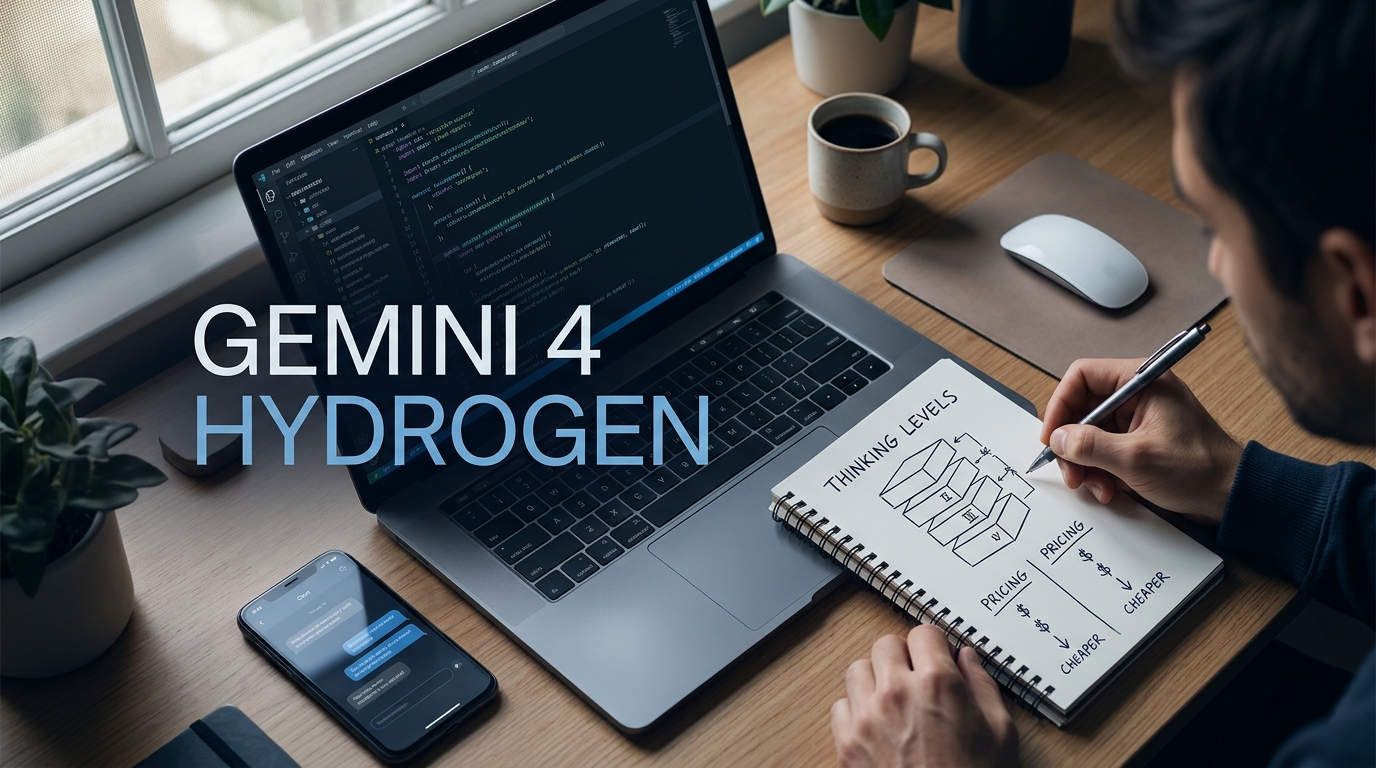
Google released Gemini 4 Hydrogen on November 12, 2026, as a fast model aimed at coding and multi-step AI agents. It is the third model in the Gemini 4 family and succeeds Gemini 3.8 Flash. Most coverage frames it as a speed and reliability upgrade, and the “cheaper” part of the story is not clear-cut, as explained below.
How this article was made: it is based on official announcements, documentation and the sources listed at the end, not on our own hands-on testing. See our editorial policy.
Table of Contents
What happened with Gemini 4 Hydrogen
Google released Gemini 4 Hydrogen on November 12 and is rolling it out worldwide in the Gemini app, Google Search and the Gemini API. The launch comes weeks after the Gemini 4 Carbon and Gemini 4 Argon frontier models. Google’s own post on X is time-stamped November 12, 2026, so some outlets date it to today and others to yesterday, depending on time zone.
According to Koray Kavukcuoglu of Google DeepMind, Carbon and Argon are meant for deep reasoning, while Hydrogen carries out tasks quickly. It replaces Gemini 3.8 Flash as Google’s everyday model and is the first of these models to drop the Flash name.
Key claims: speed, accuracy and thinking levels
Speed and fewer fabrications
Google claims Gemini 4 Hydrogen performs tasks 2.5x faster than Gemini 3.8 Flash at its default setting, with more than 5x fewer fabricated claims. Google also says it reduces excessive intervention in agent tasks by up to 81 percent. These are all Google’s own figures, not independent results.
Benchmarks
Google reports a Terminal-Bench 4.1 score of 57 percent for Hydrogen, against 18.2 percent for Gemini 3.8 Flash. That is a vendor-supplied comparison. On the Artificial Analysis Intelligence Index, it scores 51, one point ahead of the larger Gemini 4 Argon. The index figure is a third-party measure, but a one-point gap is small.
Four thinking levels
Google says Hydrogen offers four thinking levels (low, medium, high and a new xhigh tier) that scale intelligence, latency and token use in a predictable progression. In practice, you pick the reasoning depth a task needs and pay accordingly.
Pricing: is it really cheaper?
Developers pay $1.50 per million input tokens and $7.50 per million output tokens across the full 1 million token context window. VentureBeat’s headline calls it a “faster, smarter, pricier Flash successor”, and it notes that Google lists no introductory promotion for the standard tier.
So the “cheaper” framing needs care. Per-token prices are not lower than a Flash-class model by default in that analysis. The saving Google points to is the cost of finishing a task at a given thinking level.
VentureBeat’s table gives per-task cost estimates by thinking level. For high and xhigh it lists index scores of 51 and 54 at $1.87 and $3.16, and for medium and low it lists 41 and 27 at $0.80 and $0.29. I could not confirm how those costs were calculated, so treat them as one outlet’s estimate.
Caching also matters for agent workloads. On Google Cloud, automatic caching starts at 4,096 tokens, down from 6,144 on Flash, and explicit caching is unavailable at launch.
Where you can use it
- Everyone: consumers can select the model in the Gemini app and get it automatically in Google Search. Free Gemini users get access through automatic model selection when Google decides Hydrogen suits their prompts.
- Developers: the Gemini API, Google AI Studio and Android Studio.
- Paid subscribers: Google AI Pro and Ultra subscribers get access in Google Antigravity. Google AI Plus at $4.99 per month now lists Hydrogen as its headline model, with twice the free tier’s usage limits.
- Businesses: Gemini for business, Antigravity and, with a suitable subscription, Gemini in Google Sheets.
On inputs, Hydrogen accepts text, images, audio and video, and Google Cloud can ingest Office and OpenDocument files directly.
What it means for coding and agents
The agent angle is the most interesting part. Orchestrator, a new capability in Google Antigravity, lets different Gemini models collaborate within the same workflow. Hydrogen can handle coding and agent tasks directly or work alongside Carbon, with Antigravity switching models within a session.
If you build agents, the practical pattern is a cheap, fast model for routine steps and a heavier model for hard reasoning. For the heavier tier, see our earlier coverage of Gemini 4 Argon. For non-developers using Google’s tools at work, our Gemini for business guide gives background.
What to do now
- Run your own prompts at low, medium and high thinking before committing, because Google’s speed figures are measured at its default setting.
- Estimate cost per completed task, not per token. Higher thinking levels use more tokens.
- If you rely on explicit context caching on Google Cloud, check that gap before migrating from Flash.
- Compare against other routing setups, such as GitHub Copilot Fusion, if cost per coding task is your main concern.
What we do not know yet
- How Hydrogen performs on independent coding and agent evaluations beyond the Artificial Analysis index.
- Whether real workloads reproduce the 2.5x speed gain, which Google reports only against Gemini 3.8 Flash.
- Whether introductory pricing or explicit caching will arrive later. The sources I found mention neither.
Conclusion
Gemini 4 Hydrogen is a speed-and-reliability upgrade to Google’s everyday model, with a new xhigh thinking level and tighter Antigravity integration. Its headline numbers come from Google, and its pricing is not obviously cheaper per token. Test it on your own tasks before moving agent workloads over.